
The Gap in Kansas Law That Could Let Murder Defendants Walk Free
Kansas's competency system was built on two legal frameworks that were never designed to talk to each other. When they collide, the most dangerous defendants fall through.
The catalyst case: In October 2020, a relative noticed one of the boys hadn't shown up to his soccer game. Deputies arrived at the home on Hillside Road in Leavenworth County and found Logan Jackson, 14, and Austin Jackson, 12, shot dead. Their father, Donald Ray Jackson Jr., had fled with their two younger sisters, ages 7 and 3. Amber Alerts went out across four states. Six hours later, a truck driver spotted Jackson's car near the Oklahoma border. He was arrested. The girls were unharmed.
Jackson was charged with capital murder. He has been found incompetent to stand trial multiple times and has cycled through Larned State Hospital and Osawatomie State Hospital without achieving competency. Involuntary commitment proceedings have been dismissed when courts found he no longer met the statutory criteria — not because he was safe to release, but because the current law limits courts to evaluating only whether a defendant is presently dangerous within the inpatient setting, without considering the nature of the alleged crimes or the defendant's criminal history. Jackson remains not competent and has never stood trial.
His sons' mother, Tara Rieck, traveled to Topeka to testify before the Senate Judiciary Committee and ask the legislature to fix the statute that made this possible. She put it plainly: "My daughters and I need to be safe. My family needs to be safe, and if he's not somewhere safe, we're not safe."
Senate Bill 374, sponsored by Senator Jeff Klemp, passed the Kansas Senate 40-0 on emergency final action on February 18, 2026. Two days later, Judge Gerald Kuckelman ruled that Jackson must remain in custody and take medication at Larned, keeping the case alive for now. The bill moves to the House.
Two Systems, One Gap
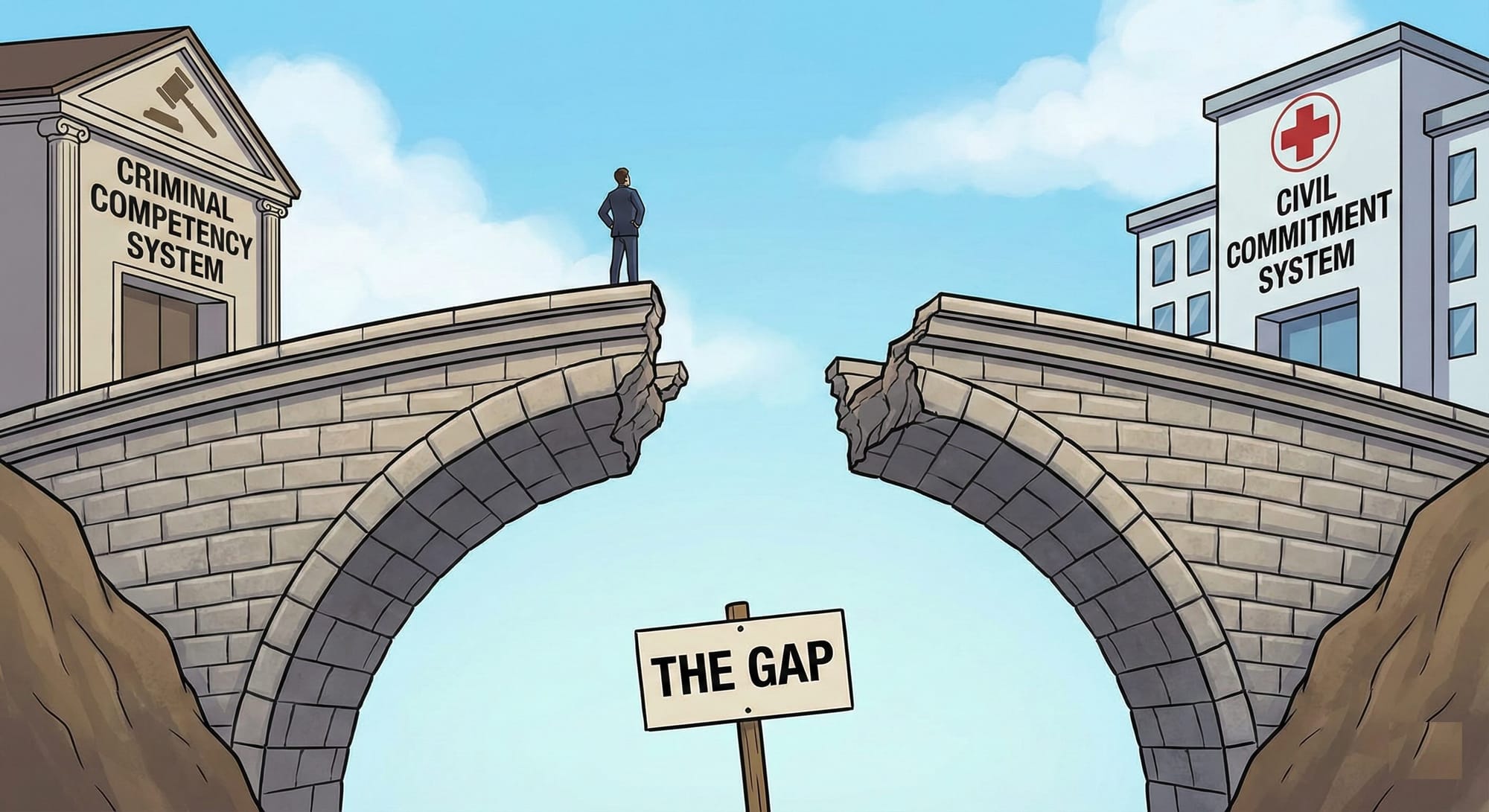
Kansas law operates two entirely separate frameworks for handling people with serious mental illness who end up in the criminal justice system. Each has its own standards, its own procedures, and its own logic. They work fine in isolation. The problem is what happens when a person falls from one into the other.
System One: Criminal Competency. When a defendant is charged with a crime and there's reason to believe they can't understand the proceedings or assist in their own defense, the court hits pause. The criminal case stops, and the court orders a competency evaluation. This traces back to a 1960 Supreme Court standard, Dusky v. United States, and Kansas codifies it at K.S.A. 22-3302. Competency is a present-tense, functional question: Can this person participate in their defense right now? It has nothing to do with guilt, innocence, or dangerousness. It's about whether the trial itself can fairly proceed.
If the defendant is found incompetent, the court orders evaluation and treatment aimed at restoring competency, typically up to 90 days of initial treatment, followed by up to six months if restoration looks probable. For many defendants, this works. They're stabilized on medication, they regain the ability to participate, and the criminal case resumes.
But for some defendants, restoration doesn't work. The mental illness is too severe, or the cognitive impairment is permanent. The treatment period expires without competency being restored. And that's when the case gets handed to the second system.
System Two: Civil Commitment. When restoration fails, the court directs involuntary commitment proceedings under Kansas's Care and Treatment Act for Mentally Ill Persons (K.S.A. 59-2946). This is an entirely separate legal process. It has nothing to do with the criminal case. It asks a different question: Is this person mentally ill, and are they currently likely to cause harm to themselves or others?
That word "currently" is doing all the heavy lifting. Civil commitment was designed for the general population of people with mental illness, not for people accused of crimes. The standard is clinical: doctors assess the person's present condition, their current behavior, their near-term risk. What the person may have done in the past, including what they're charged with, is largely beside the point.
The Gap. Here is where the two systems collide. A defendant charged with capital murder is sent for competency restoration. Restoration fails. The case is routed to civil commitment. But in the commitment hearing, the court evaluates whether the defendant is presently dangerous, and the defendant has been living in a locked, medicated, supervised hospital environment for months. They're stable. They're compliant. They don't present an immediate clinical risk within that controlled setting.
The commitment court, following the law as written, finds the defendant doesn't meet the criteria. The case is dismissed.
And then? Under current K.S.A. 22-3305, the statute uses mandatory language. The court "shall order the defendant to be discharged from commitment and shall dismiss without prejudice the charges." The prosecutor gets a 14-day window to request a competency hearing, but if the defendant is still incompetent (and they will be, because the whole reason they're here is that competency can't be restored) the statute dead-ends. Discharge. Dismissal.
This isn't a hypothetical, and it isn't one case. District and county attorneys from Leavenworth, Johnson, and Sedgwick counties testified before the Judiciary Committee that they have watched this pattern repeat with defendants charged with homicide and aggravated sexual offenses against children. Johnson County alone has eleven defendants stuck in this cycle right now, three of them charged with off-grid or severity level 1 crimes. Sedgwick County has a first-degree murder case that has been cycling since January 2022. This is happening across Kansas.
The Revolving Door
To be fair, the current statute isn't completely blind to the problem. Since 2001, Kansas law has included a modified commitment standard for defendants charged with the most serious offenses: off-grid felonies and nondrug severity level 1 through 3 felonies. For those defendants, the usual civil commitment requirements are relaxed. The court only needs to find that the defendant is "likely to cause harm to self or others," without also needing to find that they lack capacity to make treatment decisions or that their diagnosis isn't on the exclusion list.
But even this broadened standard still hinges on present clinical dangerousness — and for the reasons described above, that standard almost never captures a defendant inside a treatment facility.
So the system creates a cycle. Multiple prosecutors described it in testimony:
- Defendant is found incompetent.
- Defendant is ordered to a state hospital for restoration.
- Restoration fails after the statutory period.
- Involuntary commitment proceedings are initiated.
- The commitment court evaluates the defendant's current condition. Stable in a hospital. Commitment is denied.
- Defendant returns to the criminal court.
- Criminal court has no option but to restart restoration.
- Repeat.
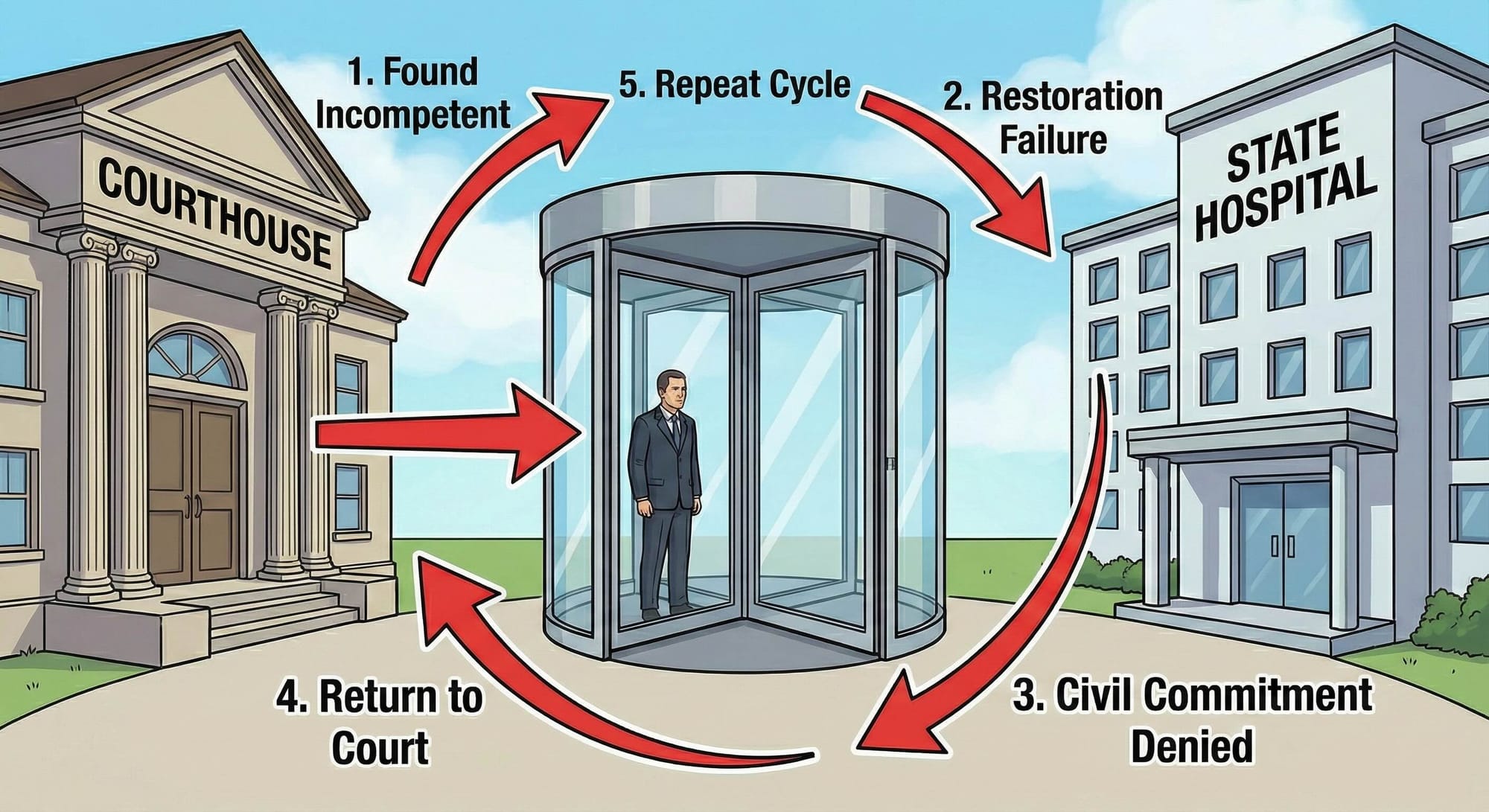
At some point, either the commitment succeeds (and the defendant stays in treatment as a civil patient) or the cycle exhausts itself and the defendant walks. Either way, the nature of the alleged crime, no matter how serious, plays no role in the outcome. A shoplifter and a capital murder defendant ride the same conveyor belt.
What SB 374 Does
Senate Bill 374 doesn't tear down the existing framework. It builds a bridge between the two systems, one designed to catch the cases where the gap poses the greatest public safety risk.
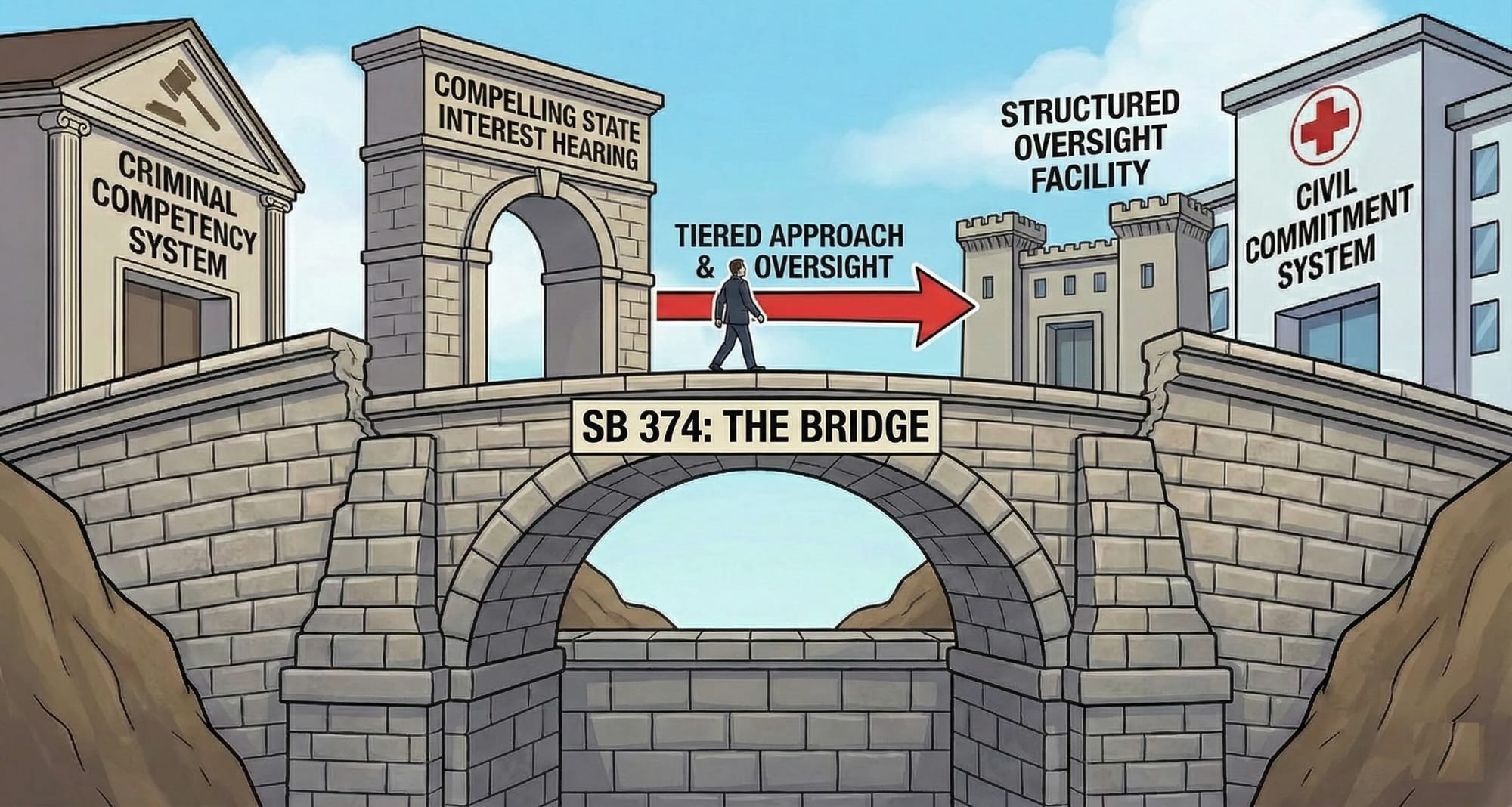
A tiered approach. The bill recognizes that not every incompetent defendant warrants the same level of continued oversight:
- Misdemeanors and nonperson felonies: Charges are dismissed without prejudice. Case closed. This is what already happens in practice for most of these cases.
- Person felonies (not off-grid or severity level 1): The court notifies the parties that charges will be dismissed unless the prosecutor objects within 14 days. If there's an objection, a hearing is held. If not, dismissal.
- Off-grid felonies, nondrug severity level 1 felonies, and specified violent and sexual offenses (including attempts, conspiracies, and solicitations): The court must set a hearing. No opt-in required. This is the tier that captures capital murder, aggravated sexual offenses against children, and the most serious violent crimes in the Kansas code.
A note on "dismissed without prejudice." "Dismissed without prejudice" in the competency context is not a standard dismissal. K.S.A. 22-3305 adds a special tolling provision that freezes the statute of limitations for the charged offense until competency is restored. The charges are technically alive in perpetuity — the state never loses its right to refile — but for defendants with permanent incompetency (which is most of the population we're talking about), that right will never be exercised. The case exists in legal limbo: not dead, but never going to wake up.
This matters for the bill's architecture. Even at the lowest tier, where charges are dismissed outright, the state isn't ignoring the crime. It is acknowledging that the constitution doesn't allow a trial when the defendant can't participate, while preserving the ability to act if that changes. For the most serious offenses, the bill goes further and doesn't dismiss at all without a hearing.
The "compelling state interest" hearing. For the most serious cases, SB 374 creates a hearing with real procedural structure. The prosecution bears the burden (preponderance of the evidence) to establish that a compelling state interest exists in ordering further evaluation and treatment. The defendant is represented by counsel. And the court must evaluate specific, enumerated factors:
- Whether the alleged offenses create a serious risk to public safety
- Whether the charges allege that the defendant actually inflicted bodily or emotional harm
- The number and nature of related charges
- The length of potential confinement if the defendant were convicted
- The number of victims
- The defendant's prior criminal, treatment, and violence history
- Whether further treatment is likely to restore competency or reduce recidivism
- Whether there is probable cause to support the pending charges
That last factor is a significant safeguard. It means the court must evaluate whether the underlying charges are grounded in evidence, not just allegations.
If the court finds a compelling interest, the defendant stays in treatment with periodic review. If not, the charges are dismissed without prejudice.
Four structural changes at the top tier. For the most serious offenses, the bill doesn't just tweak the existing system. It rewires it. First, it shifts who initiates commitment proceedings, taking that responsibility from KDADS (the state's mental health agency) and placing it with the prosecuting attorney from the criminal case. Second, it grants that prosecutor standing to appear, call witnesses, and present argument at the commitment hearing, even if it's in a different county, putting criminal evidence into what was designed as a clinical proceeding. Third, it creates a presumption of dangerousness: defendants charged with the enumerated serious offenses are "deemed likely to cause harm to self or others," shifting the burden to the defendant to prove otherwise. Fourth, it creates a looping mechanism with no statutory cap. When a compelling-state-interest hearing results in continued treatment and that treatment period ends without restoration, the process can start over. The Public Defender's office characterized this as an "endless loop."
Totality of the circumstances. Perhaps most critically for day-to-day practice, the bill allows courts in commitment proceedings to consider the full picture: prior convictions, adjudications, and pending criminal charges. Under current law, the analysis is limited to what the defendant looks like right now, in the hospital, on medication. SB 374 lets the court ask what happened before the hospital doors closed.
Ongoing judicial review. The bill also requires the treating physician to certify the defendant's status to the court within ninety days. If nothing has changed, the process cycles back through judicial review. This isn't open-ended warehousing. It's structured oversight with a medical professional in the loop.
What SB 374 does not do. It does not criminalize mental illness. Every defendant under this framework continues to receive treatment. What it does is ensure that someone charged with killing children, or sexually abusing them, or committing the most violent acts in the Kansas criminal code, is not released through a procedural crack that no one intended to build.
The Bottom Line
SB 374 passed the Kansas Senate 40-0 on February 18, 2026, on emergency final action. It now moves to the House.
The unanimous vote reflects something you don't see often in criminal justice legislation: genuine consensus that the status quo is broken. The bill's core purpose is narrow and specific. Defendants charged with the most serious violent crimes in the Kansas code should not be cycling through a procedural gap and landing back in the community without any court ever weighing whether they're a danger to the people around them.
That is what was happening. Not in theory. Not in a law review hypothetical. Prosecutors from three counties sat before the Judiciary Committee and described it case by case. And Tara Rieck, whose two sons were killed and whose two daughters she is still fighting to keep safe, drove to Topeka and asked the legislature to close the gap.
There are related challenges ahead, including hospital capacity and workforce, and those deserve their own attention. But the immediate problem, a statutory gap that left courts powerless to consider public safety for the most dangerous defendants in the system, is what SB 374 was built to close.
The question now goes to the Kansas House, and if passed, to the governor's desk.
SB 374 was reported favorably as amended by the Senate Judiciary Committee and passed the full Senate 40-0 on February 18, 2026. It amends K.S.A. 22-3303, K.S.A. 22-3305, and K.S.A. 59-2946. The bill now proceeds to the House for consideration.
Disclosure: The author, Senator Joseph Claeys, carried SB 374 on the Senate floor.
Acknowledgements: SB 374 was shaped by many hands. Leavenworth County Attorney Todd Thompson and Tara Rieck drove the effort throughout the session. Senator Jeff Klemp sponsored the bill and championed it through committee. Deputy Attorney General Jessica Domme, Sedgwick County Deputy District Attorney Aaron Breitenbach, and Natalie Scott from the Office of the Revisor of Statutes collaborated on the bill's final language. Senate Judiciary Committee Chair Kellie Warren and Vice Chair Kenny Titus were consulted throughout.